 Noctave
What's on a page of sheet music
The staff and the two clefs
A staff has five lines and four spaces; the higher a note sits on the staff, the higher it sounds. The treble clef, usually for the right hand, puts G on the second line from the bottom. The bass clef, usually for the left hand, puts F on the fourth line. At the piano, you read both staves at once, joined by a brace: that's the grand staff.
Middle C, the one in the middle of the keyboard, is written on a short extra line just below the treble staff, or just above the bass staff: the same key, in both places.
Landmarks rather than counting
First learn a few landmark notes: middle C, the G of the treble clef, the F of the bass clef, then the Cs of each octave. Then read by distance: from a line to the space touching it is the next note (a second); from a line to the next line, one white key is skipped (a third). A melody then reads like a drawing that goes up and down, and no longer like a string of names.
Rhythm
The time signature, at the start of the piece, says how many beats a measure holds: 4/4, four quarter notes; 3/4, three quarter notes. When the beat is a quarter note, a whole note lasts four beats, a half note two, a quarter note one, an eighth note half a beat. A dot after a note adds half of its length. Rests have the same lengths, with their own signs.
The key signature
The sharps or flats written at the start of each line form the key signature: they apply to the whole piece, in every octave. An F sharp in the key signature, and every F is played F sharp, unless a natural sign cancels it within the measure.
A method in four habits
- Little, but every day. Ten minutes of reading every day do more for the eye than one long session a week.
- Read before you play. Look at the clef, the key signature and the time signature; name the notes of a measure, spot what repeats, then play.
- Slowly, without stopping. Pick a tempo at which you don't stop, rather than a faster one at which you stop on every note.
- Lots of easy pieces. Sight-reading short pieces below your level, often, trains reading; a hard piece practiced for a long time mostly trains memory.
What Noctave offers for reading
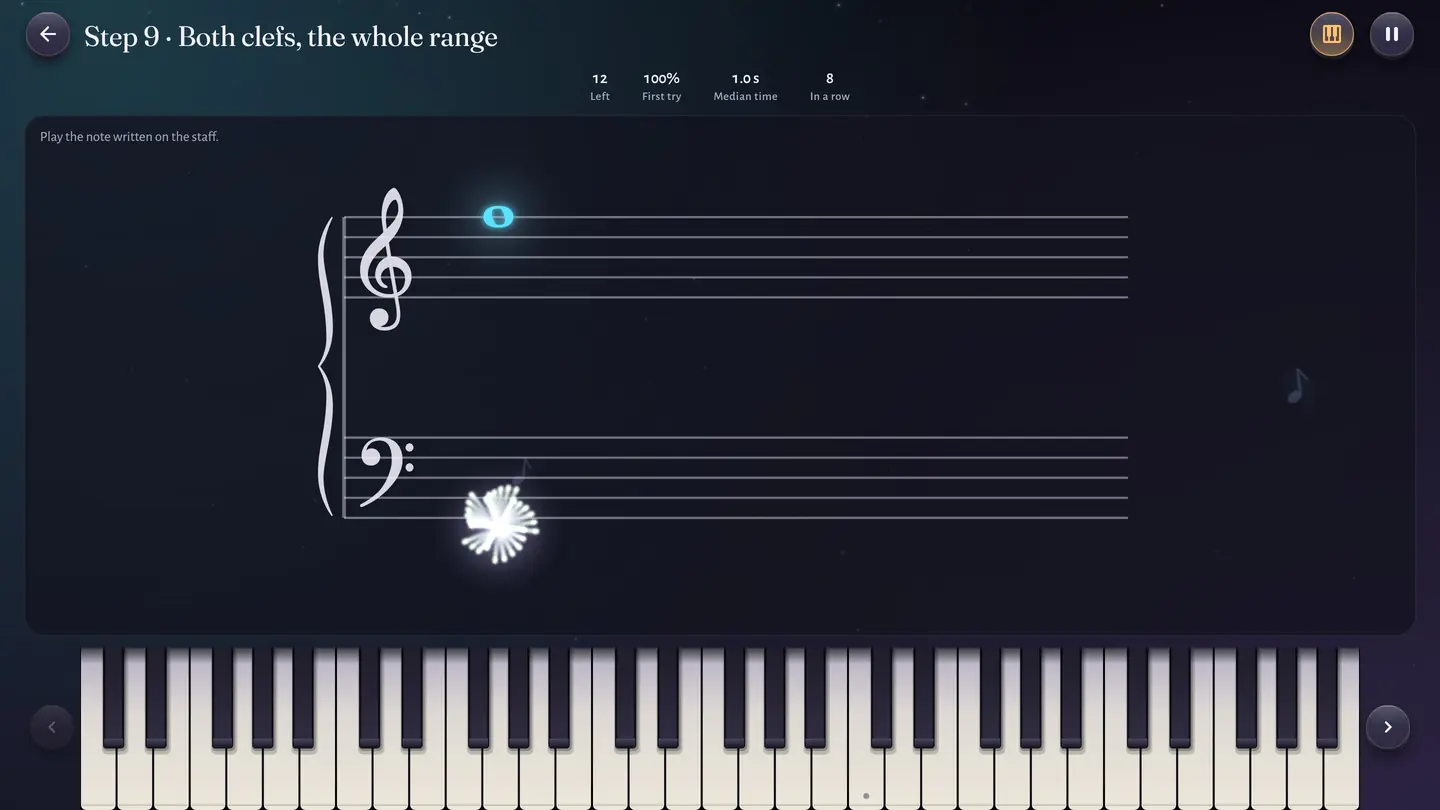
- Note reading. A note appears on the staff, you play it on the keyboard; when it's right, the next one appears at once, and a wrong key shows the note you played and its name. Fourteen steps go from middle C to every key signature, in treble clef, in bass clef, then on the grand staff, up to intervals and chords. A step is passed with 20 notes, 90% right the first time and a median answer time of 3 seconds at most. Steps 1 to 3 are free; Noctave Plus opens the next ones, the note-by-note statistics and the series aimed at your slowest notes.
- The score in sync. In Learning mode, on a tablet, the score scrolls above the falling notes; the cursor follows the music and each note you play lights up in color.
- Fading. The falling notes fade to leave you the score, in the journey as in Learning mode: it's all explained in Falling notes or sheet music.
Pieces to sight-read
To practice, choose short pieces at the easy level. Every score on this website downloads as a PDF: read it on paper, then check at the piano, with or without Noctave.
- Au clair de la luneEasy · 2/10
- GreensleevesEasy · 3/10
- Minuet in G major, BWV Anh. 114Easy · 3/10
- Minuet in G major, BWV Anh. 116Easy · 3/10
- Minuet in F major, K. 2Easy · 3/10
- Melody, Op. 68 No. 1Easy · 3/10
The next level, the minuets in minor keys and the short pieces by Schumann or Burgmüller, is described in Which piece to play for your level.