
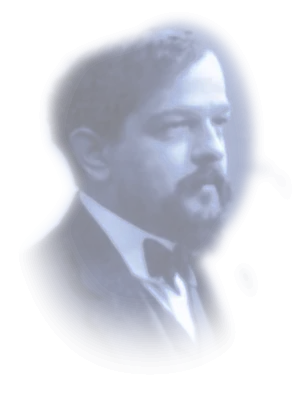
Born in Saint-Germain-en-Laye, Debussy studied at the Paris Conservatoire and won the Prix de Rome in 1884. He wrote the opera Pelléas et Mélisande and, for the piano, Estampes, Images, Children's Corner, two books of Préludes and the Études. His pieces look for new colours in chords, scales and the pedal. The catalogue has two early works, the Arabesque No. 1 (1888) and Clair de lune (around 1890, published in 1905). It also has The Girl with the Flaxen Hair, one of the Préludes of 1910.
Start with The Girl with the Flaxen Hair: a slow song with hardly any need for speed, but with six flats in the key signature and chords that glide together, to read without hurrying. The Arabesque comes next. Its triplets pass from one hand to the other and often sit against plain eighth notes: practise these two-against-three passages slowly and hands separately. Finally, Clair de lune in D-flat major asks you to hold chords across much of the keyboard and to judge the pedal so the sound stays clear.